Origins of Life
Prebiotic Chemistry • Archean AtmosphereRooted in Physical Chemistry, I study the fundamental reactions that transform simple molecules into the complex Building Blocks of Life. By connecting this Prebiotic Chemistry with the evolution of Planetary Atmospheres, I seek to understand how planetary environments create the conditions for the Origins of Life. Ultimately, understanding how a lifeless planet naturally becomes Habitable World may provide the scientific foundation for Terraforming.
Discovery of a Novel Benzene-HCN Pathway to Nucleobase Precursors
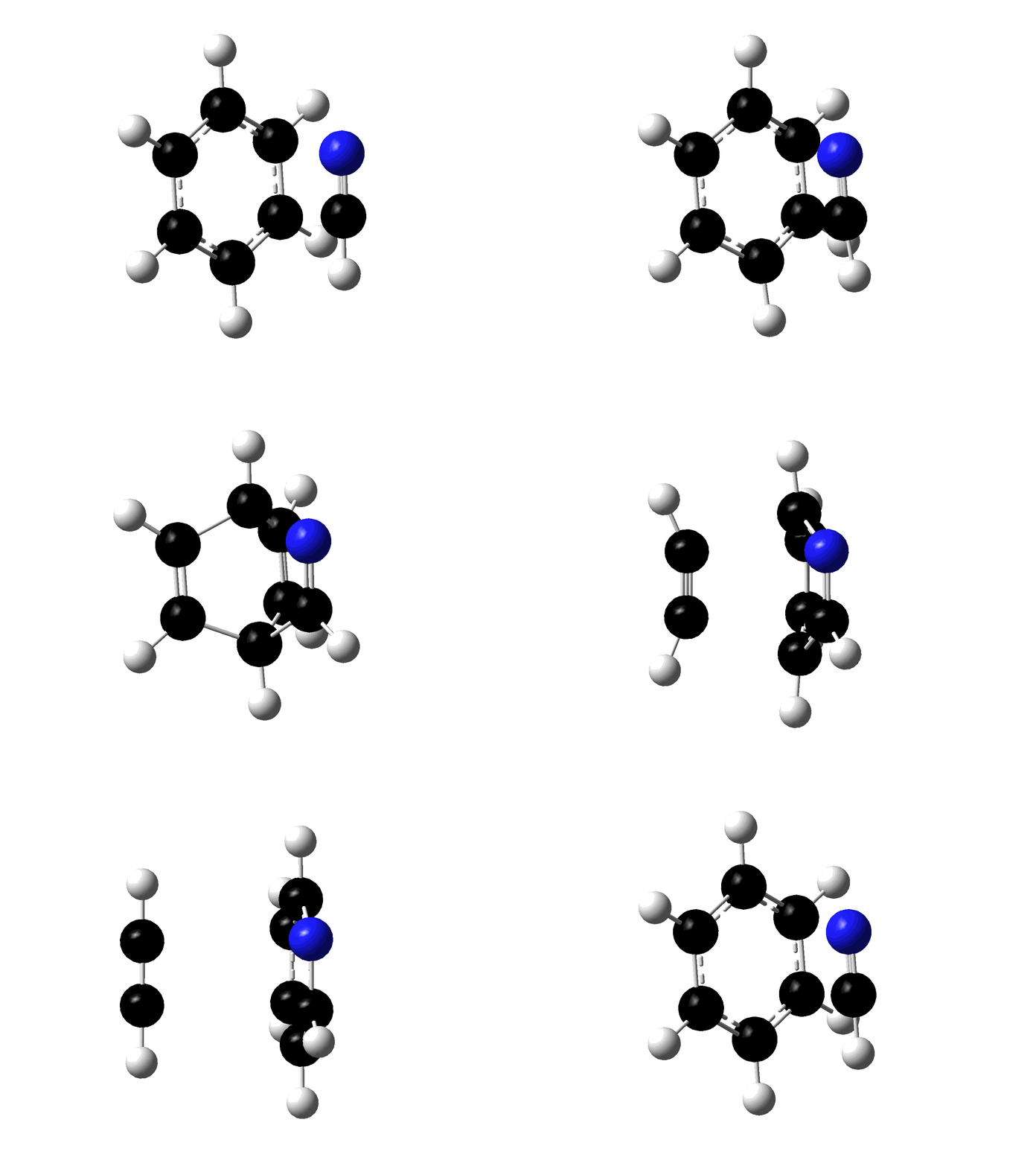
Yang, Adams, Hu & Yung, 2026, Icarus
More than three billion years ago, the right chemical conditions emerged on the early Earth for the development of life. Yet how Prebiotic Chemistry produced the complex molecular
building blocks of DNA and RNA remains one of the great mysteries surrounding the Origins of Life.
A major chemical challenge is inserting nitrogen into carbon rings to form the molecular skeletons of Purines and Pyrimidines, the foundations
of the canonical Nucleobase: A (Adenine), G (Guanine),
T (Thymine), C (Cytosine), and U (Uracil).
As illustrated in the GIF animation above, I discovered a remarkably simple pathway that accomplishes this through a single reaction mechanism:
1,4-cycloaddition/acetylene-fragmentation (CAF).
Inspired by a similar reaction type I encountered during my Ph.D. research in combustion chemistry, I found that this pathway can directly incorporate nitrogen from HCN
into aromatic carbon rings.
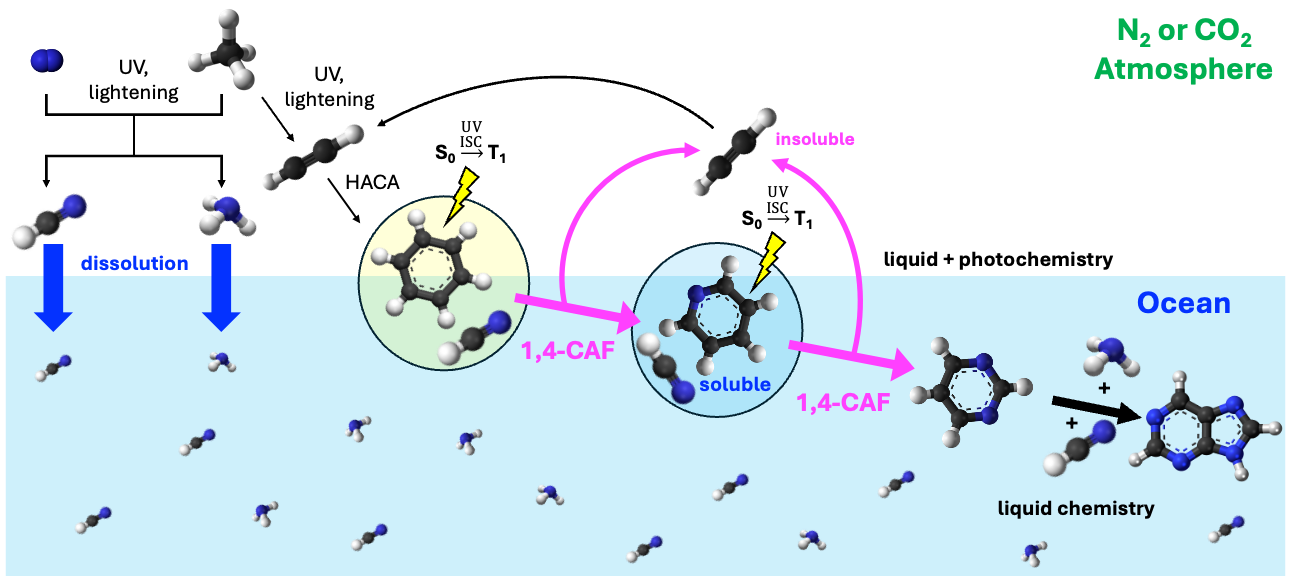
This mechanism suggests a new scenario for prebiotic chemistry in which Benzene (C6H6) and HCN
produced in the reducing early atmosphere could later undergo UV-driven chemistry in aqueous environments, progressively forming
nitrogen-containing aromatic molecules and ultimately Nucleobase Precursors, providing a new chemical pathway toward the
Origins of Life.
The work was featured in an official Caltech press release and received broad coverage from multiple science news outlets.